
ERP modernization is entering a new phase. Organizations are no longer migrating data only to support a new ERP interface or better reporting. They are creating the data foundation that AI copilots and autonomous agents will use to understand business context, make recommendations, and increasingly execute tasks.
That changes what “migration-ready” means.
Legacy data that was acceptable for human users may be too inconsistent, fragmented, poorly structured, or weakly governed for agentic AI. AI-ready ERP data migration therefore requires more than moving records from one system to another. It requires preparing data so machines can understand its meaning, relationships, ownership, and business context.
The Short Answer
AI-ready ERP data migration prepares legacy ERP data for AI and autonomous agents by improving data quality, standardizing structures, preserving business relationships, documenting metadata and rules, and enforcing governance. The objective is not simply to migrate clean records, but to create trusted, contextualized business data that agents can safely retrieve, reason over, and act upon.
Key Takeaways
- AI readiness starts with data quality, not the AI model.
- Legacy data must be standardized and contextualized, not merely copied.
- Relationships between customers, products, transactions, assets, suppliers, and processes matter as much as individual records.
- Historical data should be assessed for relevance, quality, and accessibility before migration.
- Business rules and metadata provide essential context for AI agents.
- Security, ownership, permissions, and auditability must carry into the AI-ready data foundation.
- Migration programs should measure AI readiness, not only record counts and migration accuracy.
Why ERP Data Must Change for the Agentic Era
Traditional ERP migrations are designed primarily around human users and business applications.
The objective is typically:
But autonomous agents introduce another requirement:
Microsoft's current agentic architecture emphasizes governed business data, relationships, business rules, permissions, and context as critical foundations for agents. Dataverse, for example, is increasingly positioned as an agent data platform where structured business information can provide grounding and context for AI experiences.
Consider a legacy ERP customer record:
Customer ID: 104582 Status: A Region: 03 Credit Class: B Rep: 17
A human familiar with the system may understand what these values mean.
An agent needs much more:
- What does “A” mean?
- Is Region 03 a geographic territory or operating unit?
- What does Credit Class B permit?
- Which employee does Rep 17 represent?
- What transactions are associated with this customer?
- Which business rules apply?
- Who is authorized to change the record?
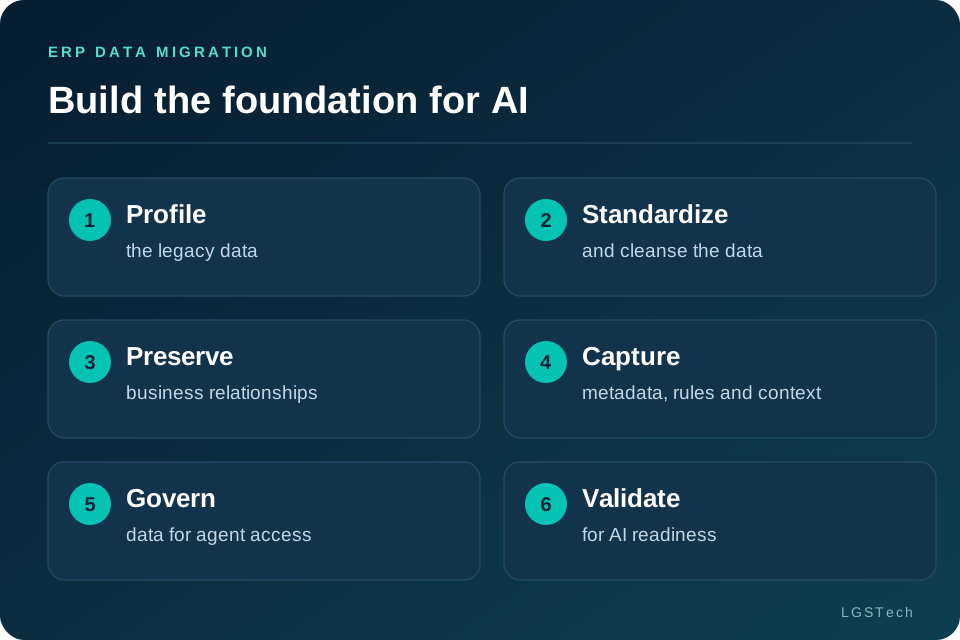
6 Steps to Make ERP Data AI-Ready
1. Profile the Legacy Data
Start by understanding what actually exists.
Assess:
- Data completeness
- Duplicate records
- Invalid values
- Obsolete records
- Data types and formats
- Reference data
- Entity relationships
- Custom fields
- Historical transactions
- Business rules embedded in legacy systems
Create a data inventory that identifies not only what data exists, but also who owns it, what it means, and how it is used.
Practical takeaway
Don't begin AI readiness with an AI tool. Begin with a data-readiness assessment.
2. Standardize and Cleanse the Data
AI systems can produce unreliable results when underlying data is inconsistent.
Common examples include:
- Multiple names for the same customer
- Inconsistent product descriptions
- Duplicate suppliers
- Different date and address formats
- Missing classifications
- Inactive records treated as current
- Inconsistent units of measure
Cleansing should establish consistent values, formats, identifiers, and definitions before migration.
But avoid cleansing data simply for cosmetic consistency.
The goal is to create business-consistent data that can support reliable reasoning and downstream processes.
3. Preserve Business Relationships
A collection of clean records is not necessarily useful to an AI agent.
Agents often need to understand relationships such as:
or:
During migration, preserve these relationships and their identifiers wherever the target architecture requires them.
This is particularly important for ERP data because business meaning often exists between records, not inside individual records.
Microsoft describes agent-ready data architectures in terms of authoritative data, governed data products, and business context rather than isolated records.
4. Capture Metadata, Business Rules and Context
This is where conventional migration and AI-ready ERP data migration increasingly diverge.
Agents need context to interpret data correctly.
Document:
- Field definitions
- Business terminology
- Status meanings
- Calculation rules
- Units of measure
- Reference-data definitions
- Entity relationships
- Process dependencies
- Data ownership
- Approval rules
For example, if a legacy system uses the status “04”, don't simply migrate “04” into the target system.
Document what “04” actually means and map it to the appropriate target business concept.
Microsoft's guidance for improving Copilot results similarly emphasizes domain knowledge, definitions, synonyms, and grounding so AI systems can correctly interpret business terminology.
Practical takeaway
5. Govern Data for Agent Access
AI readiness introduces a critical question:
Migration planning should therefore consider:
- Data classification
- Access permissions
- Sensitive information
- Data ownership
- Retention requirements
- Auditability
- Segregation of duties
- Agent permissions
- Human approval thresholds
Microsoft's current guidance emphasizes that agent access should respect organizational permissions, policies, and security boundaries.
This matters even more when agents move from answering questions to taking actions.
6. Validate for AI Readiness—Not Just Migration Accuracy
Traditional migration validation asks:
Did the records migrate correctly?
AI-ready migration requires additional questions:
- Is the data complete?
- Is it semantically consistent?
- Are relationships intact?
- Are business definitions documented?
- Can the target system retrieve the required context?
- Are permissions correctly applied?
- Can downstream AI applications use the data safely?
- Can business users validate agent outputs against authoritative records?
A useful validation framework is:
This expands data validation from a technical exercise into an AI-readiness control.
What Should Be Migrated for AI Readiness?

Not every legacy record needs to be moved into the operational ERP.
| Data type | Typical approach | AI-readiness consideration |
|---|---|---|
| Active master data | Migrate | High priority; cleanse and standardize |
| Current transactions | Migrate | Preserve relationships and business context |
| Critical historical data | Selectively migrate | Assess relevance and quality |
| Reporting history | Migrate or archive | Preserve definitions and lineage |
| Obsolete records | Archive | Maintain controlled accessibility if required |
| Duplicate/invalid data | Cleanse or exclude | Avoid polluting AI context |
The objective is not maximum data volume.
It is maximum trusted business context.
Traditional vs. AI-Ready ERP Data Migration
| Traditional migration | AI-ready migration |
|---|---|
| Focuses on moving records | Focuses on creating usable business context |
| Optimizes for system compatibility | Optimizes for data quality and machine interpretation |
| Validates record accuracy | Validates accuracy, context and relationships |
| Documents mappings | Documents mappings, definitions and business rules |
| Treats metadata as supporting documentation | Treats metadata as part of usable context |
| Primarily considers human users | Considers humans, applications and agents |
| Measures migration completion | Measures migration and AI readiness |
This does not mean every ERP migration must become an AI project. It means organizations should avoid making today's migration decisions that limit tomorrow's AI capabilities.
How Long Does AI-Ready Data Preparation Take?
There is no universal timeline because effort depends on data complexity rather than simply record volume.
| Complexity | Typical planning consideration |
|---|---|
| Single ERP, clean master data | Lower preparation effort |
| Multiple entities or business units | Additional mapping and governance |
| Multiple legacy systems | More integration and semantic harmonization |
| Heavy customizations | Additional discovery and transformation |
| Poor-quality historical data | Significant cleansing and validation |
| AI-critical use cases | Additional context, governance and validation |
For this reason, organizations should assess data complexity, quality, relationships, customizations and AI use cases before committing to a migration timeline.
The Business Impact of AI-Ready Data
Preparing ERP data for agents can create value beyond the immediate migration.
A governed data foundation can support:
- More reliable AI-assisted decisions
- Better enterprise search and knowledge retrieval
- Faster process automation
- Reduced manual data interpretation
- Better forecasting and recommendations
- More consistent business processes
- Greater reuse of migrated data across AI applications
The important distinction is that AI-ready migration does not guarantee accurate AI outcomes. Models, prompts, retrieval mechanisms, agent instructions, permissions, and workflows also influence performance.
What migration can do is provide a stronger foundation.
A Practical AI-Ready ERP Migration Checklist
Before declaring an ERP migration AI-ready, ask:
Data
- Critical records are complete and accurate
- Duplicate and obsolete data has been addressed
- Standard definitions and formats are established
Relationships
- Key entity relationships are preserved
- Reference data is mapped correctly
- Historical relationships are retained where required
Context
- Business terminology is documented
- Important fields have clear definitions
- Business rules are captured
- Data ownership is established
Governance
- Sensitive data is classified
- Access permissions are defined
- Retention requirements are addressed
- Auditability is maintained
Validation
- Data reconciliation is complete
- Business users have validated critical data
- AI-relevant use cases have been tested
- Agent access follows approved security boundaries
What This Means for Dynamics 365 Migration Programs
For organizations moving from Dynamics AX, NAV, GP or other legacy ERP platforms to Dynamics 365, AI readiness should be considered during migration planning—not after go-live.
Dynamics 365 is increasingly being positioned as an agent-ready business application platform, with agents able to operate against business data, rules, permissions and transaction processes.
That makes migration decisions around:
more strategically important.
A migration completed today may become the foundation for AI-driven operations tomorrow.
How LGSTech Helps Build an AI-Ready Data Foundation
LGSTech approaches ERP data migration as more than a technical extraction and loading exercise.
Its migration capabilities include:
- Migration readiness assessment
- Legacy data discovery and profiling
- Data mapping and transformation
- Data cleansing and validation
- Migration automation
- Historical data strategy
- Migration testing and reconciliation
- Cutover and hypercare
LGSTech supports complex ERP modernization programs including Dynamics AX to Dynamics 365, NAXT to NAXT 365, and Annata AX to Annata 365 migrations.
Explore Dynamics 365 Data Migration Services, Migration Advisory, and Data Transformation.
For industry-specific requirements, explore LGSTech's Industries and Migration Case Studies.
Is Your ERP Data Ready for AI?
Before deploying autonomous agents, make sure the data they will rely on is accurate, contextualized, governed, and fit for purpose.
Request a Migration Assessment to evaluate your legacy ERP data and identify the changes required to create an AI-ready data foundation.
Request a Migration AssessmentFrequently Asked Questions
What is AI-ready ERP data migration?
AI-ready ERP data migration is the process of preparing legacy ERP data so AI applications and autonomous agents can reliably interpret and use it. It combines traditional migration activities such as cleansing and transformation with semantic context, relationship preservation, metadata, governance, security, and validation.
Why does AI require different ERP data preparation?
Traditional ERP data migration focuses primarily on whether information can be loaded into the target system. AI systems also need consistent definitions, relationships, context, permissions, and business rules to interpret information accurately and use it appropriately.
What ERP data should be prepared for AI?
Master data, active transactions, critical historical information, reference data, business rules, and key relationships should be assessed. The priority should be data required for specific AI use cases rather than automatically moving every historical record.
Can historical ERP data be used by AI agents?
Yes, provided it is accessible through an appropriate architecture and has sufficient quality, context, permissions, and relevance. Organizations should assess whether historical data belongs in the operational ERP, an analytical platform, or a governed archival or knowledge environment.
How do you validate data for AI readiness?
AI-readiness validation should cover accuracy, completeness, consistency, relationships, business context, access controls, and traceability. Organizations should also test representative AI use cases against authoritative business data before allowing agents to use it in production processes.
Does AI-ready data migration require moving all data to Dynamics 365?
No. AI readiness is not about maximizing the amount of data in the ERP. Some historical or analytical information may be better maintained in governed data platforms or archives, provided agents can access the required information securely and with appropriate context.
How does AI-ready migration support autonomous agents?
It gives agents a stronger foundation of trusted data, relationships, business definitions, and permissions. This helps agents retrieve relevant information and operate within defined business boundaries. However, data preparation is only one component of reliable agent behavior; agent design, retrieval, instructions, security, and human controls also matter.
About the Author
Purba RayChaudhuri — B2B Technology & ERP Content Strategist
Purba specializes in B2B technology, ERP transformation, Dynamics 365 data migration, and enterprise technology content, with experience developing migration-focused content and GTM assets for complex ERP modernization programs.