
A failed ERP migration can delay go-live, disrupt operations and erode confidence in a transformation program.
A poorly prepared ERP data foundation creates a different risk: it can undermine every AI initiative that follows.
As enterprises introduce copilots and autonomous AI agents into finance, procurement, supply chain, sales and service, ERP data is no longer simply information that needs to be moved into a new application. It increasingly becomes the information AI systems use to understand the business, make recommendations and take action.
An AI agent doesn't just need a clean customer record. It needs to understand what that customer represents, how it relates to orders and contracts, which information is authoritative, where the data came from, and what actions can safely be taken from it.
Microsoft's guidance similarly emphasizes unified, secure and governed data as a foundation for reliable AI agents, alongside traceability and controlled access.
That creates a new migration imperative:
This is the fundamental shift behind AI-ready ERP data migration.
What Is AI-Ready ERP Data Migration?
Traditional migration largely follows:
AI-ready migration needs to address:
The distinction matters because clean data is necessary for AI, but it isn't sufficient.
Why Clean ERP Data Isn't Automatically AI-Ready
Consider a legacy field:
A conventional migration might map 03 to a corresponding target-system code.
But an AI agent needs to know that 03 means Strategic Distributor—and potentially much more:
- What defines a strategic distributor?
- Does the classification affect pricing or credit?
- Who owns the classification?
- Which system is authoritative?
- Can it be used to trigger an action?
The record may be perfectly accurate while its business meaning remains opaque.
This creates an important distinction:
Data quality: Is the data correct?
AI readiness: Is the data correct, understandable, contextualized, traceable and governed well enough to support a decision or action?
Microsoft's data-agent guidance similarly emphasizes descriptive data structures, business terminology, relationships and clear instructions to improve an agent's interpretation of enterprise information.
The Hidden Cost: AI-Readiness Debt
An organization can successfully migrate its data, go live on the new ERP and discover months later that its AI initiatives require another major data-preparation exercise.
Teams may have to rediscover:
- what legacy fields meant
- which source is authoritative
- how entities were mapped
- which business rules were transformed
- why records were excluded
- how historical relationships were preserved
That creates AI-readiness debt.
The business impact is straightforward:
Rework: data has to be cleansed and interpreted again.
Risk: AI systems may act on ambiguous, incomplete or poorly governed information.
Delay: every new AI initiative spends time rediscovering business definitions and relationships.
The smarter approach is to capture this knowledge while the migration team is already discovering, transforming and validating the data.
Where Legacy ERP Data Creates AI-Readiness Debt
Legacy ERP environments accumulate more than old records. They accumulate business knowledge.
1. Cryptic codes and inconsistent terminology
Values such as ORD_STATUS = 7 may be obvious to an experienced employee but meaningless to an AI system without the corresponding business definition.
Migration implication: Mapping must capture business semantics, not just field equivalence.
2. Business rules hidden outside the data model
Important logic may reside in custom code, workflows, integrations, spreadsheets, user-defined fields and operational procedures.
Migrating the database without understanding these rules can preserve the records while losing the logic that gives those records meaning.
3. Relationships that exist implicitly
ERP information rarely operates in isolation.
Consider:
A conventional migration may confirm that each record arrived. An AI agent may need to traverse the entire relationship to answer:
That could require customer, order, product, pricing, discount, cost and return information.
4. Data without lineage
An AI system increasingly needs to know:
- Where did this information come from?
- Which system is authoritative?
- When was it updated?
- What transformation was applied?
- Can it be trusted for this decision?
That makes lineage and traceability increasingly important as AI moves into operational processes.
The Six Layers of AI-Ready ERP Data
The framework can be assessed through six layers:
1. Data
Is the record accurate, complete and consistent?
2. Semantics
Does the system understand what the record means?
3. Context
Does it understand the relationships and business rules surrounding it?
4. Lineage
Can the information be traced to its source and transformation history?
5. Governance
Are ownership, security, permissions and usage controls defined?
6. Actionability
Can an AI agent safely use the information within a defined business process?
Three ERP Examples That Reveal the Problem
Customer data
A legacy system may contain:
ABC Industries ABC Ltd ABC Industrial
A conventional migration may treat them as separate records.
An AI-ready migration asks:
The objective isn't simply to remove duplicates. It is to preserve the business identity and context of the customer.
Inventory data
Suppose the ERP reports:
Is 500 actually available to promise?
The number may need to account for allocated stock, safety stock, quality holds, damaged inventory and warehouse transfers.
An AI agent needs the business definition of availability, not simply the numeric value.
Order status
STATUS = 7 might mean Partially Fulfilled.
But perhaps 80% has shipped, 20% is backordered and one line was cancelled.
An agent answering:
"Can we promise delivery tomorrow?"
needs more than the status code.
From Migration Metadata to an AI Asset
Every major migration generates valuable metadata:
- source-to-target mappings
- transformation rules
- business definitions
- data-quality rules
- lineage
- exceptions
- reconciliation rules
- ownership
- validation results
Historically, much of this becomes project documentation after go-live.
That is a missed opportunity.
Consider:
Customer Status Definition: Commercial relationship status Source: Legacy ERP Target: Dynamics 365 Values: Active / On Hold / Closed Business owner: Finance Transformation: Legacy status codes standardized Authority: Dynamics 365
This information is useful during migration. It can also become machine-readable business context for future AI applications.
Deloitte similarly describes ERP as continuing to provide trusted data, auditability and standardized processes even as AI agents increasingly operate around the ERP core.
Validation Must Evolve from Reconciliation to Semantic Validation
Traditional migration validation asks:
AI-ready validation asks:
That creates three levels of validation:
Level 1 — Data validation
Record counts, field values, totals and duplicates.
Level 2 — Business validation
Balances, relationships, business rules and master-data consistency.
Level 3 — Semantic validation
Definitions, classifications, terminology, context and lineage.
A migration can pass technical reconciliation while still losing business meaning.
What This Means for Dynamics 365 Migrations
For organizations moving from AX to Dynamics 365 Finance & Operations, NAV to Business Central, SAP to Dynamics 365 or other heavily customized ERP environments, this approach is particularly relevant.
Legacy systems may contain years of:
- custom fields
- obsolete codes
- duplicate master data
- historical transactions
- custom business rules
- integration dependencies
- inconsistent classifications
Simply reproducing that complexity in a modern ERP creates a modern application with legacy data problems.
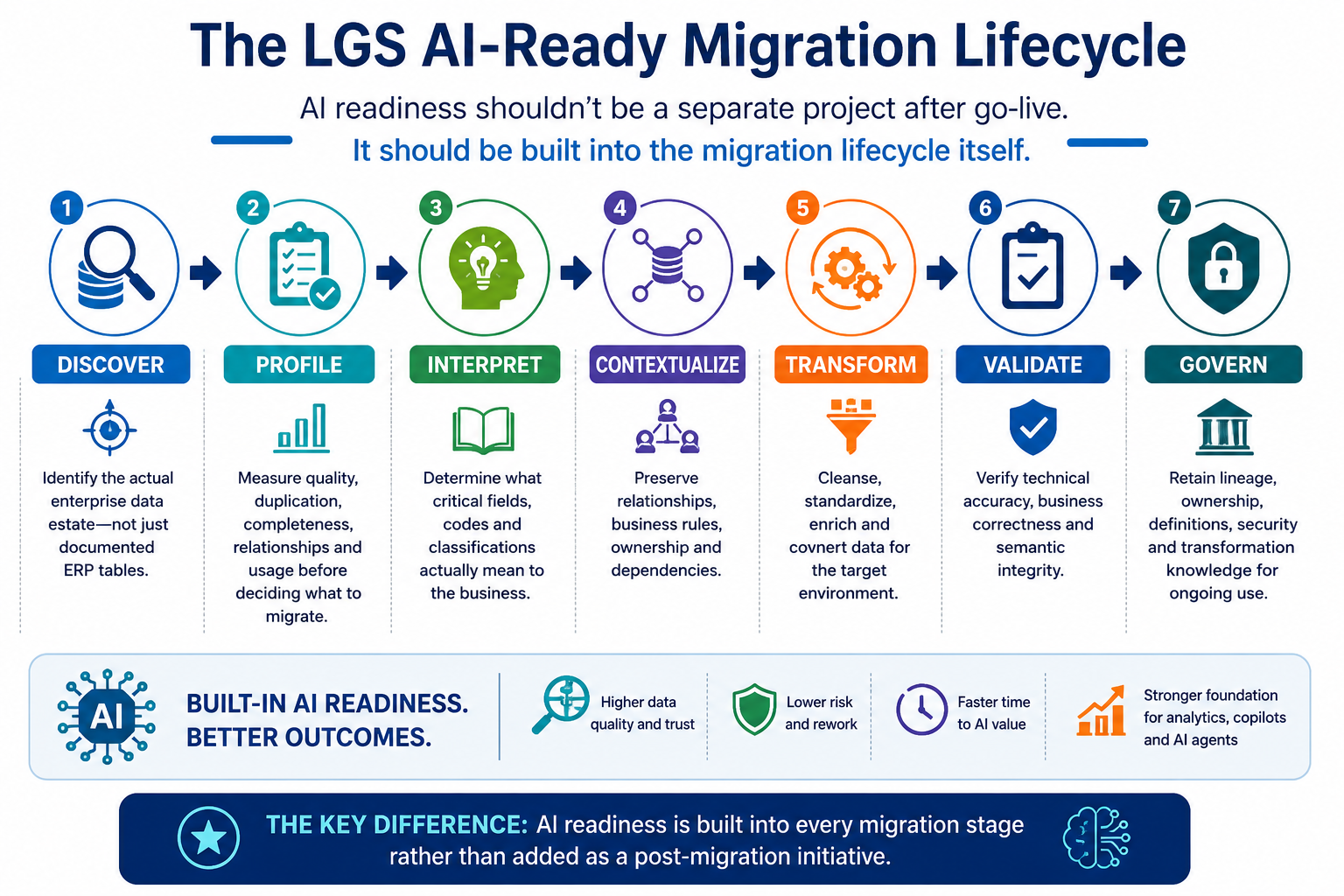
A stronger migration lifecycle is:
The result isn't simply a successful ERP cutover.
It is a trusted enterprise data foundation that can support analytics, copilots and AI-enabled business processes.
The Executive AI-Readiness Checklist
Before approving your next ERP migration, ask:
- Can we explain what our critical legacy codes mean?
- Have we identified business rules hidden outside the ERP database?
- Can we trace critical data from source to target?
- Have we identified authoritative sources for conflicting data?
- Have we preserved relationships between critical ERP entities?
- Are migration mappings and transformation rules being retained?
- Are we testing semantic correctness—not just record counts?
- Which migrated data will eventually be consumed by AI agents?
If several answers are "no," the migration may be ERP-ready—but not yet AI-ready.
The Business Case: Don't Create a Second Data Transformation Project
The business case for AI-ready migration isn't simply "better AI."
It is about avoiding the cost of preparing the same enterprise data twice.
A conventional migration optimizes data for the new ERP today. An AI-ready migration additionally captures the meaning, context, lineage and governance that future AI initiatives will need.
That can reduce:
- duplicate data-cleansing efforts
- repeated mapping exercises
- uncertainty around data provenance
- delays in launching AI use cases
- risks associated with poorly understood enterprise data
A New Definition of ERP Migration Success

For years, ERP migration success meant:
The next generation should aim higher:
AI doesn't reduce the importance of a trusted ERP data foundation.
As AI agents move closer to operational decision-making, the quality and context of the data they consume becomes both an enterprise risk and an enterprise advantage.
That is why AI readiness should begin when the migration team first discovers the legacy data—not after the ERP goes live.
Organizations that get this right won't simply move legacy data into a modern ERP.
Frequently Asked Questions
What is AI-ready ERP data migration?
AI-ready ERP data migration prepares legacy ERP data so it is accurate, semantically understandable, contextualized, traceable and governed for modern ERP, analytics and AI use cases.
Is clean ERP data enough for AI?
No. Clean data is necessary but insufficient. AI systems also need business definitions, relationships, context, lineage and governance.
When should AI readiness be addressed in an ERP migration?
During discovery and mapping—not after go-live. Business meaning, relationships and transformation rules need to be understood before migration is executed.
How does AI change ERP data migration?
AI changes migration from primarily a technical mapping exercise into a broader process of data discovery, semantic interpretation, contextualization, transformation, validation and governance.
Can Dynamics 365 migrations be made AI-ready?
Yes. Dynamics 365 migration programs can incorporate deeper data discovery, profiling, semantic mapping, transformation, validation and lineage so the resulting data foundation is better prepared for analytics, copilots and AI agents.